About Men Scryfa
Extras
Men Scryfa
at 427/353, near Men an Tol. Inscribed Stone with possible cross
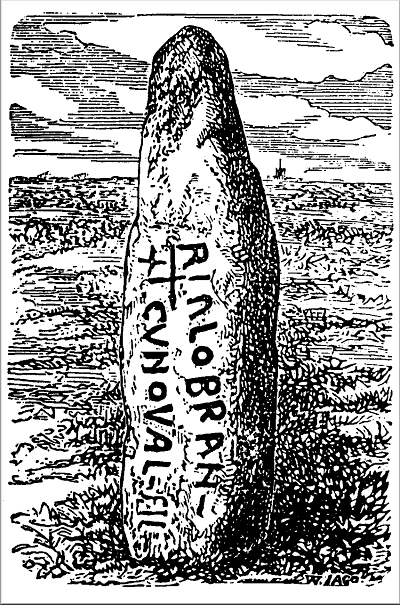
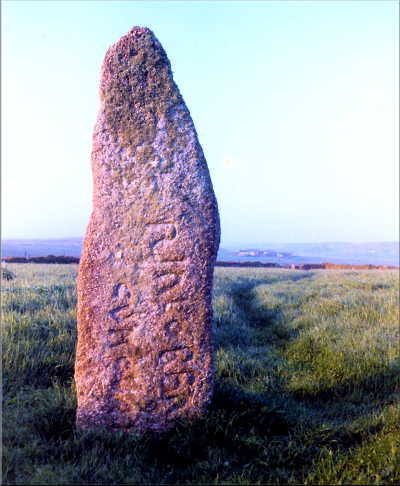 “The Men Scryfa itself has a cross at the beginning of the inscription, and there is no reason to question that this cross is the Christian emblem.” So wrote Rev.Iago in the late 19th century who made a drawing of the stone showing two incised crosses. However their existence has always been in doubt and, on balance, their presence is highly questionable.
Although this six foot high inscribed pillar now stands in the middle of a cultivated field this was not always so. In the early part of the eighteenth century William Hals described Mayne Screffes as being a “monument set up of a rough perpendicular stone”.
It had been drawn about 1700 by Edward Lluyd and, in a letter dated 5th January 1712, the stone is described as then lying in a three foot deep pit “by the road which leads from St.Ives to St.Just” (ie. the present Tinners Way). Presumably it lay face upwards otherwise the inscription could not have been read.
Drawing of the stone by Rev.Iago in JRIC 1871
 Dr.Borlase shows an engraving of the stone with its inscription and considered that, since the “heathens” were averse to commit anything to writing, it must be a Christian monument set up before it became usual to place the cross before the name. The stone was re-erected in 1824 at the same time as the nearby Lanyon Quoit was restructured by Captain Giddy of Logan Rock infamy. Twenty five years later the ‘Stone of Writing’ once again lay on the ground.
A letter dated 8th October 1849 on the protection of national antiquities tells how: “Being in its (Men Scryfa's) immediate neighbourhood the other day, I was surprised at missing it from its accustomed place in the view... standing as it formerly did in the midst of furze and heath, its lighter colour rendered it still more conspicuous. On examination, I discovered it lying prostrate in the croft where it had stood, but which, having recently been broken up for tillage, has been cleaned of all but this and a few other blocks too large to admit of their easily being carted away, except piecemeal.”
The writer was told by “a respectable countryman” that the farmer, who was also the owner, had dug around it looking for treasure and so caused the stone to fall. A short time later Blight made an ink sketch of the stone lying in a pit with its inscribed face uppermost; he wrote that it had been: “upset by Nicholas Bottrell of Bosullow in 1849 under the idea that he would find a golden crown and sceptre under money under it!!!” The lower piece of projecting stone as drawn by Borlase was missing.
Men Scryfa [Moyle (1726): 204]
 Since Richard Edmonds wrote during 1851 that the position of the stone did not allow the inscription to be read, Blight may have used artistic licence to draw the lettering from Borlase’s published work.
In 1861 it was still lying in “a small hollow, in an inclined position”, but about five years later Copeland Borlase described the stone as “standing” and this is confirmed in Murray’s guidebook published in 1862 — “It (Men Scryfa) has been raised, and is now a conspicuous object. The inscription can easily be read”. The stone was inserted into the ground at a deeper level than previously so that the lowest part of the inscription can no longer be seen.
Men Scryfa [Blight Miscellaneous: 46(9)] Reproduced by permission of the Morrab Library Penzance.
 The two vertical lines of incised lettering read RIALOBRANI CUNOVALI FILI — a Latinised version of the local Celtic language. The final letter ‘I’ of each word was written horizontally, a fashion common during the 5th/6th centuries, hence giving a rough date for the inscription approximately translated as ‘of the Royal Raven son of the Glorious Leader’. The raven, a large black carrion bird associated with death and battle, was venerated across much of northern Europe as an important symbol of military victory thought to have magical powers. The inclusion of the father’s title shows the son to have legitimate royal ancestry, essential in sanctioning authority as a tribal leader. Men Scryfa is, even without any cross, likely to commemorate a newly converted tribal leader still clinging firmly to his pagan roots.
Privacy: we're not interested in your private data. This site collects stats to observe traffic in general only. we're not into capturing data, giving or selling your data to others or making mailing lists. Any problems, contact the webmaster. Enjoy your visit! | Website built with love by Palden Jenkins in West Penwith, Cornwall