Menhirs in Paul
Definite Menhirs
Menhirs in Paul
PAUL 1
CASTALLACK CARN menhir
at 4474/2537, in an area of scrubland, marked on OS as Standing Stone.
Castallack Carn – the stone covered in vegetation
 This 1.8 metre (6ft) tapering stone stands in overgrown scrubland about twenty metres from a public footpath and, almost totally covered by ivy, is very difficult to locate in summer when the area is full of vegetation.
When I visited the site in November 1996 I only found the stone by locating a tall green column of ivy rising above the browns and blacks of dead bracken, bramble and blackthorn bushes.
In a paper read by Blight on 28th April 1865 to the Royal Institution of Cornwall* he refers to notes made by Crozier about 1850. These notes mentioned “a stone, 5 feet high, which stood within a hundred yards of the Castallack Round, and from which the Pipers at Bolleit could be seen”.
The stone during the early 1970s. Reproduced courtesy of John Michell.
 Copeland Borlase visited the stone on 15th May 1871* but does not appear to have made any excavation. Henderson described* the menhir as a “fine well-chosen stone which although smaller than most of its kind is at once recognisable as a menhir”; he noted that, although the Pipers were visible, it was uncertain whether this was mere coincidence or intentional: two drawings he made show the stone standing in open ground with none of today’s tangled mass of vegetation.
Michell thought* it an insignificant stone “hard to find and scarcely worth the trouble”. The SMR records* that a pit 1 metre (3ft 4in) in diameter and 0.3 metre (1ft 1in) in depth had been dug on the eastern side of the stone. When this was done is not known although Russell wrote* that she explored the area around the base of the stone during 1951 but recorded no finds.
PAUL 2
CHYENHAL menhir
at 4505/2750 in a cultivated field, marked on OS as Standing Stone.
 A 2.6 metre (8ft 6in) triangular-sectioned stone stands close to the hedge of a cultivated field overlooking nearby farm buildings with extensive views towards the north and west – two other stones were formerly in the next field [see PAUL 6].
Blight recorded* an eight foot high menhir which was later noted by Halliwell* as being an irregularly shaped block of unhewn granite tapering towards the top in a wedge-like form: “It now answers the ignoble purpose of a rubbing post for the cattle” and he was informed by a very old man at the farm that it had been there all his days “and had always been spoken of as a stone erected by the ancient people”.
Henderson remarked* on the smoothness of the stone’s surface suggestive of having been “roughly dressed with very rude and rough implements”: his map of the parish shows only this stone, not the two in the next field. Michell thought* it an “unremarkable stone” and wrote how the farmer was unable to throw any light on the two stones formerly in the next field. Russell saw the menhir in February 1959 and noted* that, since it was unsteady, it could not be deeply embedded; she later quoted a 19th century source* that the stone was “replaced” in an erect position by Sir Rose Price – hence implying that it had fallen down.
PAUL 3
KERRIS menhir
at 4439/2742 in a cultivated field, marked on OS as Standing Stone.
 A 2.35 metre (7ft 9in) triangular-shaped block of granite, having a base 2.9 metres (9ft 6in) broad, stands in a cultivated field close to the public footpath from Tresvennack to Kerris in an area where three ancient stones of differing shape form a straight line over a distance of about 800 metres (half a mile).
Although not listed by Blight in his publication of 1856* he did note this stone as a menhir in an article published in 1865* and remarked that in medieval times a cross stood very near this stone “its socket base having been destroyed within the last year; the cross itself had previously disappeared”.
C.Henderson Antiquities Vol.2: 64. Reproduced courtesy of the Royal Institution of Cornwall
Cooke 1999 after PWCFC Vol.1 Pt.4: 172
 The ground around the long sides of the base was excavated by Copeland Borlase in May 1871 “but without any result” – only a pebble and a flint were unearthed.*
 However, some eighty years later, a small complete stone pendant was discovered on the surface of the ground near the foot of the menhir; the roughly pear-shaped dull dark-red piece of sandstone had an hour-glass perforation and, although commonplace in Brittany, these are rarely found within a megalithic context in Cornwall: “Some people regard these pendants as charms worn around the neck, whilst others see them as ritual objects”.*
PAUL 4
TRESVENNACK menhir
at 4418/2787 in a cultivated field Park Veryan (field of ants?) TA(1841) No.973 – the field immediately to the east was called Longstone, marked on OS as Tresvennack Pillar.
 All fields farmed by William Trembath.
797 – Averack
961 – Park-an-Chy
964 – Littens
966 – Reens
967 – Hill Croft
973 – Park Veryan
975 – Long Stone
976 – Park Mere
1207 – Park Nicholl
1208 – Germans
Rough sketch from TA1841
J.T.Blight (1856): 66
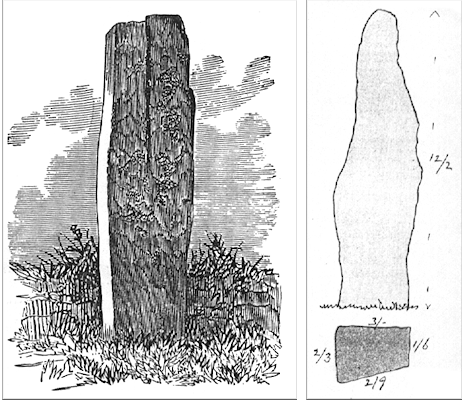
 At 4 metres (13’3”) tall this menhir rivals the Pipers in height and stands close to the field hedge; it is square-sectioned, with an ancient vertical split running from the top to about half way down the stone that, nonetheless, remains solid. The site is in a sheltered fertile area of the peninsula from which several other contemporary standing stones are in view including The Blind Fiddler and the pair of stones at Higher Drift.
W.C.Borlase (1872): 104
 Blight recorded the stone as being 12 feet tall and drew it together with an urn found close by. Copeland Borlase also drew the stone on the same day that he had excavated at Trelew and visited the Blind Fiddler at Trenuggo; he noted it as being 11’6” above the ground and that the farmer informed him of an urn discovered on the eastern side, although he had found nothing more after digging four feet (1.2m) all around the base of the menhir. The interesting discovery of the urn was fully described by Borlase:
“The most important discovery, however, of incinerated remains at the foot of an obelisk, was made in the year 1840, by the tenant at Tresvennack, in the parish of Paul. The monument in this case is placed on the summit of elevated ground, about a mile and a half to the south-east of the Trenuggo Stone, while the estate on which it is situated joins that of Trigganeris, where the two menhirs with a grave between them, previously described, are situated (i.e. SANCREED 2). The height of the Tresvennack pillar, a sketch of which is here inserted, is 11 feet 6 inches above ground, and about four feet below. The stone itself, which, like the others, is granite, seems to have been selected with considerable care. It presents a much more symmetrical appearance than any of those just described, being perfectly upright, and tolerably squared at the angles, though seemingly unhewn.
The farmer, while engaged in turning up that portion of his field, which, from its proximity to the pillar, the plough could not reach, struck his tool against a flat block of stone, eighteen inches square, lying in a horizontal position, at the distance of about two feet from the eastern side of the pillar. This stone being turned up, a pit was discovered, cut out of the solid clay soil, and unprotected by side stones or walling of any description.
W.C.Borlase (1872): 103 Lukis (1885) Plate xxx
 In the centre of this pit stood an urn, the largest perfect one yet found in Cornwall, and belonging to a type of sepulchral vessel that must be noticed more fully at a subsequent page. It stood with its mouth upwards, and contained the larger fragments of the calcined bones of a human body, among which was a molar tooth; while the smaller and more splintered pieces, together with wood ashes, were scattered throughout the rest of the pit. The vessel is formed of yellowish clay, obtainable in the vicinity, it is hand-made, and the exterior scarcely sufficiently baked. The interior on the contrary is hard and blackened by fire, the ashes having been doubtless swept into it, while still red hot, and left to smoulder within. The handles (a common feature in Cornish urns) are in this instance remarkably large, and neatly put on; but one, as will be seen, differs from the other in shape and size.
The small urn, which accompanies the large one in the above cut, was found 18 inches to the northeast of it. It was also standing on its base, without a covering stone or protection of any sort. The mouth is in consequence much broken. It was filled with snuff-coloured powder. The Penzance Natural History and Antiquarian Society, among their many obligations to that gentleman, owe a special debt of gratitude to J.N.R.Millet, Esq., of Bosaverne, for the preservation of this interesting relic; and no less so to those ladies who took infinite pains to restore the urn to its original form, from the countless fragments into which it had been broken”.
Privacy: we're not interested in your private data. This site collects stats to observe traffic in general only. we're not into capturing data, giving or selling your data to others or making mailing lists. Any problems, contact the webmaster. Enjoy your visit! | Website built with love by Palden Jenkins in West Penwith, Cornwall