The Enigma of the Menhirs
Extras
The Enigma of Menhirs
[Six web-pages]
Egyptian solar obelisk, Temple of Karnak
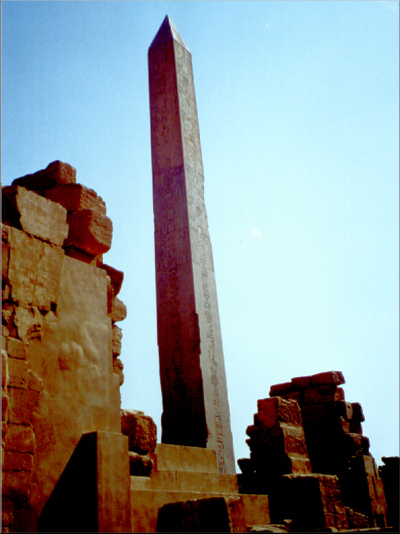 SO WHAT WAS the prime function of the standing stone? This question, the most often asked of any type of prehistoric monument, is the hardest to answer and must of necessity be partly a matter of guesswork and personal prejudice. The answer can be approached from several angles – archaeology, astronomy, geology, anthropology (folklore and customary tradition), and through alignments with each other.
Suggested uses have included tombstones or memorials to important events;* remains of idolatrous worship;* religious and ceremonial whereby the “grey weather-beaten stones were set up to represent dead warriors or tribal leaders”;* fertility ceremonies or “more obscure rites”; meeting places or guide posts;* marking boundaries of one type of land or land use placed so that they were easy to see, particularly from other menhirs.*
Dr.Borlase, Vicar of Ludgvan and St.Just, the ‘father’ of Cornish archaeology, took many of his ideas regarding menhirs from Biblical sources and suggested that their first use was religious, being used to mark places of worship, annual sacrifice, and adoration, but that they were then used for other purposes including places of election and council, making civil contracts, military memorials, trophies, and a location for feats and games in honour of the interred hero; he also considered them to be places of witchcraft.*
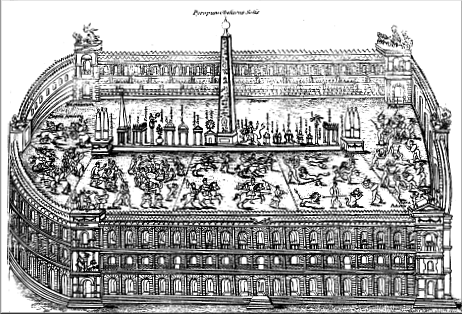
Stone as God – solar obelisk in the Roman Circus. [Kennett (1812)]
 Although it is, of course, very precarious to mechanically transpose the practices of one culture into another, it does help to give an idea of the kind of purpose human beings thought appropriate for erect stones and much can be gleaned from ancient written sources to show how standing stones were perceived and used in various societies. Old Testament references to the erection of standing stones and associated forms of worship indicate some of the possibilities.
“Jacob rose up early in the morning, and took the stone that he had put for his pillows, and set it up for a pillar, and poured oil upon the top of it...and this stone, which I have set for a pillar, shall be God’s house”.*
“And Jacob set a pillar upon her grave, that is the pillar of Rachel’s grave unto this day”.*
Use of stones as objects of worship was totally unacceptable to later Jewish prophets since stone, at that time, was associated throughout the ancient world with worship of the Goddess and the Sun. Stones representing female deities were normally rounded, conical, or a pillar with rounded tapering top.* The Goddess, revered under a great variety of names – Innana, Astarte, Aphrodite, Cybele, Isis – was worshipped at Paphos (in Cyprus) in the form of a conical stone instead of a statue* while at Byblus, the oldest city of Phoenicia located on the coast of Syria, Astarte had her greatest sanctuary where, in an open court surrounded by cloisters, “rose a tall stone, or obelisk, the holy image of the goddess”.*
Perhaps the most well known case of the Goddess as represented by a stone is that concerning Cybele’s journey to Rome in 205BC. The Senate was told by the Sibylline oracle that the Carthaginian army under Hannibal could be expelled from Italy if the holy idol of Cybele was brought from its home in Phrygia (central-west Turkey) to Rome. Ambassadors were sent to King Attalus, who was then allied to Rome in war against the Macedonians, and the small vulva-shaped black stone, probably an ironstone meteorite in which the Goddess was believed to reside, was transported in a ship made of pinewood cut from her sacred mountain to the port of Ostia from where it was taken amid great ceremony to the Temple of Victory in Rome.* Two years later Hannibal was decisively defeated!
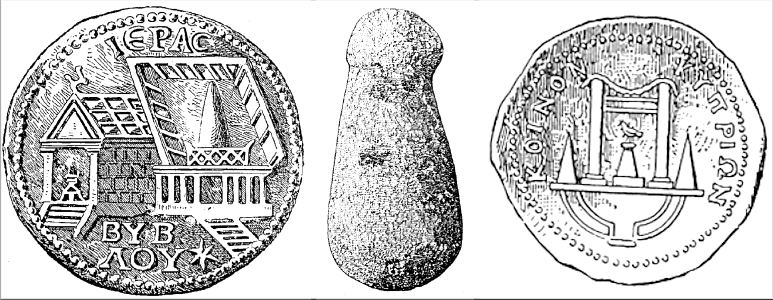
Left: A Phoenician coin from Byblus showing the goddess as a cone within a temple. [Rawlinson (1889): 146]
Centre: A 15cms (5½”) “object of stone, probably a Priapus”, one of many such items unearthed in Troy by Schliemann at the end of the 19th century. [Schliemann (1880): fig.683]
Right: Stone as Goddess – conical stones in a Phoenician temple: Cypriot coin from the 1st millennium BC. [Rawlinson (1889)]
But stone, even a conical black or white stone, did not necessarily symbolise a female deity. Phoenicians and Hebrews both worshipped the sun as prime divinity, The Divine Father, who was symbolised by an erect pillar of stone – in Egypt the sun god and representative of generative power, Amun-Ra, had the obelisk as his hieroglyph.*
A conical black stone, supposed to have fallen from heaven, was the symbol of Syrian sun worship with its centre at Emesa* and, when the 15-year-old Syrian prince-priest Elagabalus was proclaimed emperor, he had the sacred relic taken to Rome where he ‘married’ it to the goddess Astarte of Phoenicia.*
Centuries earlier Augustus had an obelisk of Rameses II brought to Rome from Heliopolis in Egypt and set up in the Circus Maximus as an offering to the sun – it was later surmounted by a cross.*
Pliny observed that obelisks were sacred to the sun whose rays they represented both in form and by name, and that they were frequently associated with images of the sun god Apollo.*
Use of conical stones seems to have arisen from the perception that deities resided on mountain tops close to the heavens, mountains often topped in winter by snowy mantles of frozen water or dark clouds heralding rain – water being so obviously essential to life in the hot Mediterranean summers.* Mountains and rocky summits are shown on coins of the Mediterranean region as consecrated deities.*
Stone effigies of various deities were, during the Classical period, worshipped throughout Europe as simple stones – shaped or otherwise – or as sculptured human beings.* There is good reason to believe that some of these stone ‘deities’ did actually fall out of the sky as meteorites. As Akerman puts it: “In a superstitious age, the descent of a huge substance resembling no terrestrial production, amidst fire and smoke, and the crash of thunder, was certainly sufficient to inspire those who witnessed the event, with superstitious amazement and dread, and lead to the belief that it was the missive of a deity”; adding that “artful priests” may well have manufactured counterfeit meteors to impress the “credulous and superstitious”* in much the same manner as later Christian monks created ‘saintly relics’ from any human remains readily available to them.
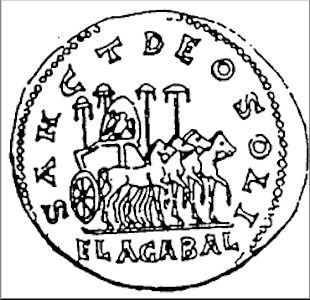 The Holy Sun God depicted as the sacred stone of Emesa being borne in a chariot – coin of the Roman Emperor Elagabalus AD 218-222. [Cooke 1998 after Sear (1964)]
THERE ARE indications that the cult of erecting standing stones during the Bronze Age were replaced during the pre-Roman Iron Age with phallic-shaped wooden posts and unambiguously phallic stones. It is of course possible to find ‘phallic’ and ‘female’ stones in the many examples of standing stones in Western Europe but, although many of these stones are tall thin pillars, they were not necessarily intended as phallic symbols. However, where the top of the stone has been deliberately shaped to resemble the glans of the penis there can be little doubt what was originally intended. For obvious reasons very few such stones have survived destruction by religious prudes. Only a handful is known in the British Isles.
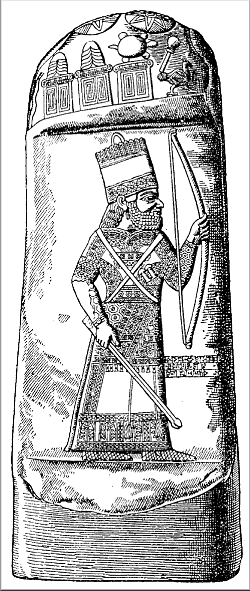 A Babylonian boundary stone, dated to about 1100 BC, inscribed with the purchase deed of a plot of ground. The figure suggests that the stone had a protective function and the overall shape of the stone a possible phallic one as well. [Bible (1896) Plate CXI]
As late as 1872 a stone at Tara in Ireland was known, presumably from its shape, as The Phallus of Fergus;* one still stands in the graveyard of the church at Aghowle in County Wicklow (Ireland) and another such stone, at St.Olan’s church at Aghabulloghe in County Cork, had the knob-like glans knocked off its five foot high shaft during the 18th century by a clergyman who disapproved of its use by villagers as the focus for rituals trying for healing and easy childbirth. There is evidence that in remoter parts of western Britain phallic-shaped standing stones were discovered by antiquarians during the 19th century but were considered to be “too embarrassing” for gentlemen to report; most were “quietly made to disappear; broken and/or buried”: one stone however survives at Clackmannan near Stirling.*
Some ‘Celtic’ stones have no double meaning about them. A phallic stone was recorded* over one and a half metres (5ft) above ground where it was re-erected next to the church at Irlich (Neuweid, Germany): it owed its preservation to “piety and superstition” in a region that was a centre of Celtic civilisation and full of Celtic graves. The stone had been used as a Celtic tombstone; probably copied by local Celts from the Etruscans of northern Italy where these types of stones are well known. In earlier times it was believed that the phallic gravestone gave sanctuary to a murderer who managed to touch it but in more recent centuries it was thought to promote child bearing.
A few other ‘penis stones’ exist in Germany and Northern Jutland (Denmark), dated to the 4/5th and 12th century respectively; one of the German examples being decorated with spirals and a cross. And from Cornwall comes a hint of phallic stone worship during the 6th century from the biography of Saint Samson.* When travelling across the hundred of Trigg the holy man “saw men worshipping a certain phallus after the custom of the Bacchantes by means of a lewd play”; he rebuked the “idolators” who pleaded “that there was no harm in their commemorating their parents’ wedlock in a play”. Samson converted the pagans by means of a miracle and destroyed the idol that is considered to have been a menhir carved to represent a phallus.*
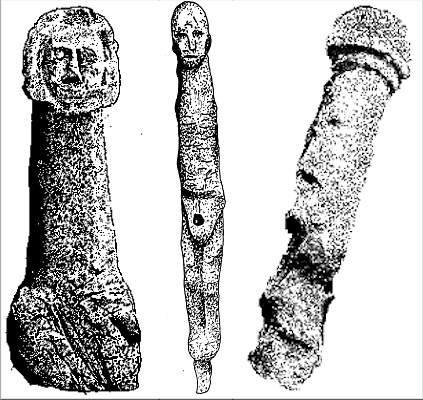 Left: The front face of a 1 metre (3’3”) high Romano-British ‘serpent stone’ from Maryport.
Centre: A carved wooden figure nearly 1½ metres (5’) tall from a bog in County Cavan, Ireland, one of only a handful of full-length figures known in Britain – dated to the 1st century AD or 6th century BC. [Cooke 1999 after Megaw (1989): 227]
Right: An African carved figure.
WHETHER this type of stone monument replaced (or preceded) earlier Celtic phallic-shaped wooden posts is unknown. What is known is that archaeology and the writing of Classical authors show that the Celts worshipped wooden idols – selection of the wood used being made with great care so that certain deities were equated with certain trees – and, in a few specific locations, it has been established that stone columns were constructed to replace simple ritual timber posts. In addition there are many instances of stylised human wooden figures from the Celtic period in which the body, arms, and legs are formed into a rough cylindrical shape surmounted by a large head having facial features – the whole object having distinct phallic overtones.
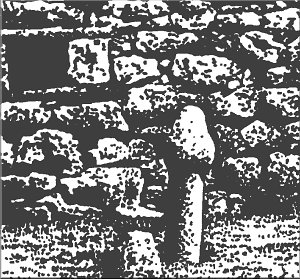 Phallic stone of unknown date in the churchyard at Aghowle, County Wicklow, Ireland. [Cooke 1998, after photograph in Bord (1983): 54
The pillar stones of Celtic cultures, which assimilated much of the preceding Bronze Age cultures and continued across most of Europe well into the Roman Imperial era, were often surmounted with a human head having phallic overtones connected with ritual. Imagery of the head frequently has a decidedly phallic shape with the fertility dimension exaggerated by being shaped like the glans of the penis. It is well attested that the Celts had a ubiquitous cult of the severed human head.
According to Dr Anne Ross, an expert on the Celtic world, the human head was “the most highly significant sexual symbol of all for the Celts”.* Evans Wentz affirms that there is “very much first-class evidence” suggesting that the prehistoric standing stones (menhirs) of Western Europe were regarded by the “primitive” Celts as an abode of a deity or seat of divine power. Also as a phallic symbol inseparable from a Celtic sun-cult: “because among all ancient peoples where phallic worship has prevailed, the sun has been venerated as the supreme masculine force in external nature from which all life proceeds, while the phallus has been venerated as the corresponding force in human nature”.*
Although only slight evidence exists for these early stone and wood phallic pillars there is a large body of Roman literary evidence to show that rumbustuous fertility rituals, in which images of the phallus took pride of place, were common throughout the Empire. Rituals continued well into Christian times as evidenced by numerous edicts forbidding them [see below] and the blatant sexual shape of many of these fetishes attracted the attention of Church authorities who waged a constant battle against unacceptable pagan ‘idolatry’. This suggests that such rituals, and presumably the cult objects which accompanied them, were much more widespread than is suggested by survival of material artefacts.
Privacy: we're not interested in your private data. This site collects stats to observe traffic in general only. we're not into capturing data, giving or selling your data to others or making mailing lists. Any problems, contact the webmaster. Enjoy your visit! | Website built with love by Palden Jenkins in West Penwith, Cornwall