Enigma 2 | Hermae and Termini
Extras
The Enigma of the Menhirs 2
Hermae
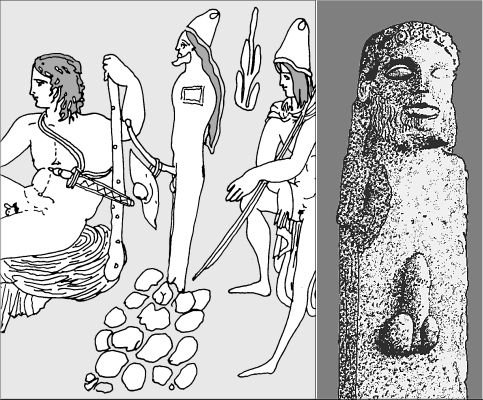 Left: Humorous decoration on an Attic vase depicting an ithyphallic herm being used as a hat peg. Note the heap of stones into which he has been placed – so giving continuity to the more ancient form of boundary mark. [Cooke 2000 after Carabelli (1996): fig.18]
Right: A marble herm dated to about 520 BC from Siphnos, a fertile mountainous island in the Western Cyclades. [Cooke 2000 after Miles/Norwich (1997): 99]
USE OF BOUNDARY STONES to delineate the lands of tribe, clan or extended family is very ancient and had both a practical and religious function, more especially in agricultural and semi-agricultural communities. Not only did they mark out the territory on which a particular group derived their means of subsistence from growing crops and grazing animals, the stones also acted as a ‘protection’ against malign human and supernatural forces. Since continuing fertility of the land was, and still is, an obvious requirement for human survival, these markers had a sexual affiliation as well as a protective one. Once society came to be dominated by masculine power structures so did boundary stones come to be associated with phallic and martial properties. The erect phallus signified creative potential and the hard unyielding stone itself, unlike timber, was an object of enduring constancy unaffected by nature’s unpredictable periods of drought, storm and flood.
Stones were used as landmarks placed on property boundaries and along public roads, usually at crossroads and junctions. In their most primitive state they were just a simple heap of stones and it was customary for passers-by to throw another stone onto the pile as an offering, so creating an ‘erection’ associated with resident spirits. When spirits became identified with mythological gods and goddesses – human and animal – and named as individuals within the extensive pagan pantheon, boundary stones developed into simple carved angular pillars with the head of the deity on top and a pair of male genitals, usually erect, added to the front of the stone to emphasise his generative and protective aspect.*
In Greece these boundary stones were known as hermae from their later association with the god Hermes, who was originally represented as a mature bearded man looking after flocks of animals and presiding over business affairs (ie. trade in livestock). In Classical times, around the middle of the first millennium BC, after urbanisation had led to a vast increase in vigorous commercial activity and society had become ever more obsessed with youthful physical beauty, Hermes was more frequently depicted as an athletic young man who, as one of the sons of Zeus, Father of All the Gods, showed particular cunning and enterprise.
As guardian of a person’s (or group’s) land, Hermes was concerned with the trading of produce derived from it. Since this almost always involved making a journey he also became the patron of travellers – in early times, voyages were usually only undertaken for commercial purposes – and this made him a messenger for all the gods, of which there were a great many, his speed symbolised by wings on his hat and sandals. Following on from these attributes the god became associated with profit (lawful and unlawful); of eloquence – successful trading demands much discussion and bargaining – and of games of chance or risk. As a protective deity he was also responsible for dispensing justice and punishing wrong doers.* Hermae were set up in many Greek market places, neutral land where rivals could meet for purposes of trade under protection of the deity.
The messenger of the gods acts as a guide, escorting the souls of the dead into Hades, as well as having the ability to lead them back from the underworld into the world of the living and restore them to life.* Hermes also knew the fruitful ‘underworld’ of woman’s womb – his fertility attributes allowed him to ‘know’ the dark erect phallus inside the hidden black interior of woman entered through her vulva.*
In the summer of 415 BC a scandal shook the very foundations of Athenian society when hermae throughout the city were castrated as preparations were being made for a huge military expedition to subdue Sicily to Athenian rule.* Castration of the hermae – Thucydides (c.471-400 BC) reported that they “had their fronts cut up all around”* – took place during the approximate time when women of Athens were celebrating the festival of the Adonia.* It was an event that precipitated the fall of Athens as a Mediterranean power.
Another god closely identified with the herm that, initially, specifically watched over farms and gardens, was Priapus. He also protected property boundaries (i.e. the latent fertility of a family’s land) and crude wooden representations of him were to be seen all over the countryside – he was often called Saviour of the World.* His icon – simple pillars adorned with a head of the deity and large erect phallus similar to those of Hermes – were treated with great reverence and regularly garlanded and crowned with flowers, usually hung from a transverse bar placed just below the head to make a cross-like shape,* an image having many conceptual similarities with the much later Christian wayside cross. More formal images showing the fertility of Priapus depict him with a basket of produce at his feet, or holding fruit or children in his cloak.* In spring he was decked out with roses, in summer with thorns, in autumn with grapes or vine branches, and in winter with olives.*
Schliemann, the late 19th century excavator of Troy, noted that Priapus was, in mythology, the offspring of Aphrodite and Dionysus, born in the neighbouring city of Lampsacus where he was venerated well into historic times: according to Athenaeus this deity was originally an epithet for Dionysus and identical with him. Other ancient texts describe how Priapus was a warlike god who had previously been taught dancing and that he was also a sun god because of his generating power: he was “the protector of the fields, the dispenser of fertility, the tutelary deity of shepherds and goatherds, of the rearing of bees, of horticulture, the cultivation of the vine, and of fishery”.*
Many of the attributes of Hermes and Priapus, and much of their ritual, were incorporated into the cults of the Roman gods Terminus and Mercury, and it is worth noting that Julius Caesar wrote that the god most revered by the Gauls was Mercury (ie. he was the native god with attributes closest to his Roman equivalent) and that “they have many images of him”.* Was Caesar perhaps referring to wooden and stone pillars having a phallic significance or shape?*
Termini
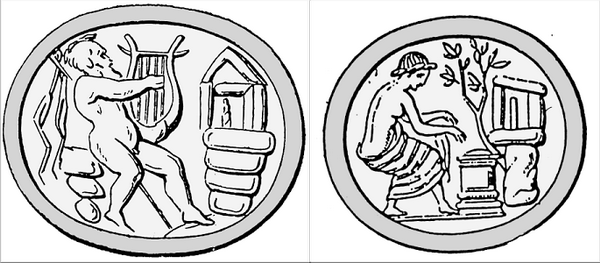 Left: Antique gem depicting a naked Silenus playing before a rural shrine “whereupon is set up the proper emblem of his god”. [Cooke 1999 after King (1872) Vol.2: Plate 27 (7)]
Right: Many Romans decried use of human and animal images to depict their deities – here a Roman woman appears to be making an offering before an open-air altar containing a small phallic pillar. [Cooke 1999 after King (1872) Vol.2: Plate 37 (5)]
THE OLD ROMAN gods belonged to a nation living by laborious agriculture and stock raising, and engaged in almost constant aggressive and defensive warfare against neighbouring city-states. Productivity (fertility) and protection were therefore the main requirements asked of the gods although deities had hardly anything to do with love – even Venus does not appear in the oldest priestly records.*
In common with other ancient cultures, early Romans habitually used upright stones as part of their religious rituals concerned with boundaries and the land. Celebrations were held during an annual festival towards the end of February – the Terminalia – when neighbouring farmers would meet at a particular stone that was then decorated and sprinkled with the blood of a sacrificed victim. This took place as part of a ritual designed to promote fertility of the land, probably having origins in prehistoric society when the stone was not simply the abode of a spirit but was itself endowed with magical power.
There was no older god worshipped by the Romans than Terminus (‘of the extremity’). His image was at first a simple long stone or even just a tree stump – later on a phallus was added to denote his principle function. Each family Terminus could be interpreted by the group as their own axis of the world around which life and the universe revolved.
Later, when the Roman State was created, this rural celebration took place at the 6th milestone on the Via Laurentina, at one time the boundary of Roman territory – the Ter-minus of the State was represented by a stone placed in the great temple of Jupiter on the Capitol.* It was Terminus who sanctified boundaries not boundaries that sanctified him: it was the greatest sacrilege to remove or desecrate these stones.
The phallic content of the Terminalia is difficult to assess since so much has been, and still is, censored out of relevant literature and museum artefacts. But it is worth noting that ithyphallic gods concerned with fertility were often just represented by an erect phallus rather than the whole human or animal shape, and that worship of the male organ of reproduction was widespread throughout the Mediterranean region from at least the middle of the first millennium BC onwards.*
So some, if not all of these Termini may, like their Greek counterparts – the Hermae – have been intended to represent the divine fertilising and protective phallus. Terminus became the deity of all boundaries, in particular the god standing between heaven and earth – a messenger between the secular world and realm of the gods – and was later humanised as the winged (and sometimes phallic) Mercury.
Another form of sacred pillar known from Roman sources during the first century BC was called the Jupiter Column, found all over areas of the former Empire – over 300 are known in Alsace-Lorraine alone. As protector of the city and father of all the gods Jupiter had his ancestry in rustic Roman fertility worship long before the city was founded. These pillars typically consist of a four-sided carved pedestal, usually depicting two male and two female deities, above which is a seven or eight-sided stone showing other divinities supporting the main shaft of the column surmounted by an image of Jupiter himself who may hold a wheel or thunderbolt, thus showing him to be intimately connected with the sun and the sky.*
Jupiter columns were a fusion of the Classical Roman sky god and indigenous Celtic solar divinities, the wheel being a ubiquitous Celtic solar symbol and the thunderbolt an emblem of the sky god who produces rain. The deity is usually depicted as a warrior on horseback overcoming the forces of evil and darkness in the form of a serpent-like creature* – prototype of St.Michael and St.George slaying the dragon.* A suggestion that these stone pillars superseded (or supplemented) Celtic sacred trees and wooden pillars is shown by the Romano-Celtic monuments frequently having the main shaft decorated with a bark or leaf pattern.*
Privacy: we're not interested in your private data. This site collects stats to observe traffic in general only. we're not into capturing data, giving or selling your data to others or making mailing lists. Any problems, contact the webmaster. Enjoy your visit! | Website built with love by Palden Jenkins in West Penwith, Cornwall