Menhirs in Sennen
Definite Menhirs
Menhirs in Sennen
SENNEN 1
TREVE menhir
at 3545/2556
in a hedge between two fields, marked on OS as Standing Stone.
A 2.45 metre (8’) stone stands in a field hedge on the border of Treve and Mayon tenements to the west of Sennen Church from where it is visible: to the west there are panoramic views over the Atlantic Ocean to the Isles of Scilly.
Blight did not list this stone although Charles Henderson considered* that it was this stone, rather than that at Trevear,* which was intended as Blight’s monumental pillar – an error possibly due to a printer’s misprint. Henderson appears to be the first person to draw and record the Treve stone as a menhir: he thought that a large portion had been broken off the top, which is level, and then built into the hedge at the foot of the menhir. The upright portion, described as well-shaped and a splendid monolith, was noted as being nine and a half feet (2.85m) in height, with the broken piece a further five feet (1.5m) high.
C. Henderson Antiquities Vol.1: 74
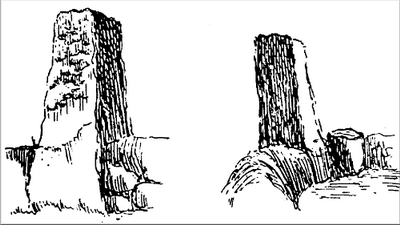 An Ordnance Survey visit during 1960* reported that the stone tapers slightly towards the top and that the broken portion seemed too wide to have ever come from the top of the longstone, as well as being the wrong shape to have belonged to the base. Another visit to the site during 1985* noted that the menhir seemed to taper at the base “as if it may not be well embedded”, and that other large stones were also set upright, seemingly on the ground, in the same hedge. Russell found “no present signs” of Henderson’s supposed broken piece from the stone.*
SENNEN 2
ESCALLS
destroyed ?pair? of menhirs, not marked on any maps.
Blight was the first to mention a menhir at Escalls.* It was 4.5 metres long by 0.93 metres wide and 0.78 metres thick at the base which tapered towards a point at the other end (14’.6” x 3’ x 2’6”). However, William Bottrell, the Victorian folklorist born in 1816 at Raftra in the neighbouring parish of St. Levan, wrote in some detail about this site:*
“There is another pair (of menhirs) near Newbridge, and one may be seen lying prostrate in Escols Lane, Sennen, at a short distance from the stile on the pathway to Escols village. There is a tradition that this menhere was taken down from where it stood, in the middle of the field, by a giant, who lived in Escols, by him rolled into the hedge, and his son, ten years of age, placed the trigg (propping stone) as we may still see it. An old lady of Escols informed me that the other stone of the pair was in a hedge at no great distance, prostrate also. The erection of these huge monoliths proves that the animal powers and mechanical skill of our ancestors were of no mean order.”
There are no field names in the vicinity relating to ancient stones and the final fate of these menhirs remains a mystery. Russell listed* a “prostrate stone in hedge by road” but unfortunately does not say if she actually saw it, nor does she give a grid reference.
Privacy: we're not interested in your private data. This site collects stats to observe traffic in general only. we're not into capturing data, giving or selling your data to others or making mailing lists. Any problems, contact the webmaster. Enjoy your visit! | Website built with love by Palden Jenkins in West Penwith, Cornwall