West Penwith and the Megalithic Era
Introducing Ancient West Penwith
This four-page introduction gives the essentials about what's on this site.

West Penwith, the ancient Belerion, is rich in prehistoric sites - and it's a good place to research them.
A concise, distinct area in size and boundaries, it is surrounded by sea cliffs on three sides and a landward energy-boundary formed by St Michael's Mount, Trencrom Hill and St Ives Head. These three sites go back at least 5,500 years to the Neolithic 3000s BCE.
Many people who live in Penwith or who visit are interested in prehistory, so there has been a lot of thinking about ancient remains here. Since 1986 much of it has been communicated through the magazine Meyn Mamvro.
While West Penwith's sites aren't big and dramatic, they form an integrated system, creating one enormous, networked cliff sanctuary of national significance. At the other end of Britain are the Orkney islands, also with many ancient sites.
On top of Trencrom Hill, a Neolithic tor and Iron Age hill camp
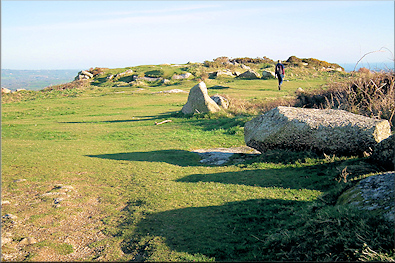 Penwith has a rather special magic atmosphere today - you can feel it. Its landscapes, cliffscapes and seascapes are uplifting and spectacular.
At the far southwestern end of Britain, on Europe's Atlantic edge, it has the highest density of ancient sites in Europe. Strange, for such a small area.
In ancient times Penwith was a focal hub for maritime traffic. It was well connected, much visited and exposed to influences from elsewhere, yet it was very much in its own world, as it still is today. It was a consecrated landscape, a shining, scintillating land with a rather insulated, protected atmosphere to it.
The Megalithic Era
Gurnard's Head and Pendeen Watch behind, from Carn Naun
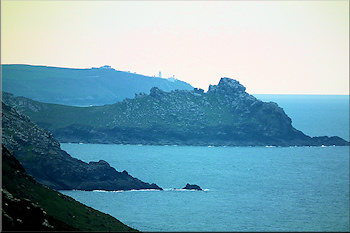 Prehistoric Europe's megalithic culture stretched along the Atlantic seaboard from today's Portugal and Galicia (NW Spain) to Brittany, Ireland, Britain and southern Scandinavia. It also affected parts of France, Germany, the Low Countries, Sardinia and Malta.
West Penwith lay at a maritime nodal point in this culture zone.
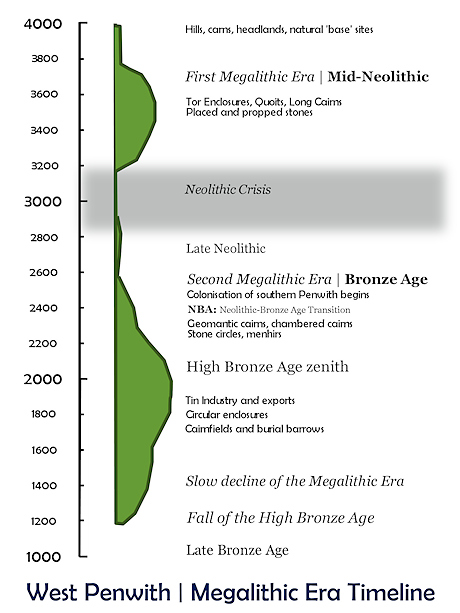
There were two main megalithic periods in Penwith. One, in the Neolithic 3000s, starting around 3700 BCE, lasted for 500 years.
The other, the Bronze Age, from around 2500 BCE, lasted around 1,200 years. Actually, it went from from the end of the Late Neolithic through to the end of the Mid-Bronze Age.
The Bronze Age zenith lasted around four centuries from around 2200 to 1800 BCE.
These were two very different periods, yet there was a continuity to them too.
The Neolithic 4500-2500 BCE
People lived and thrived in Penwith during the Mesolithic period of the 6000s, 5000s and 4000s BCE, but in Cornwall things hotted up in the Neolithic with the building of the first megaliths, around 3700 BCE.

A rich and thriving period unfolded for 500 years in the Neolithic, between 3700 and 3200 BCE. Then things went wrong and activity died off in Penwith. This led to population decline and likely emigration between 3200 and 2900 BCE, caused possibly by a climatic downturn or a pandemic. There is no clear evidence of activity in Penwith for 700 years until around 2500. This brought a two-century transition from the Late Neolithic to the Bronze Age, called the NBA or Neolithic-Bronze Age transition, during which the next phase cranked up.
Early Bronze Age 2300-1200
 The megalithic era of the Bronze Age lasted over a millennium, starting around 2500 BCE and eventually declining from 1500 onwards. It finally ended around 1200 during a climatic downturn and cultural decline.
In the Late Bronze Age after 1200, no more megalithic sites were built. To the people of the time, these ancient temples had become history. They were respected though peripheral to people's daily lives.
The Late Bronze Age, from 1200-800ish BCE, was very different to the Early-to-Mid Bronze Age, the megalithic period. It was a time of warlords, territoriality and hard work. However, a new society of farmers, traders, artisans and tribal aristocrats was taking shape, laying the ground for the Iron Age, which in Cornwall lasted from 800ish BCE to 200ish CE.

The Bronze Age zenith around 2000 made megalithic Britain an advanced, influential civilisation with connections to Crete, Phoenicia, Greece and Egypt. Tin from Penwith was traded as far as Syria and Gaza.
Geomantic knowledge and principles of the megalithic era were remembered in the Iron Age. This was the time of the Druids, inheritors of the Bronze Age mages of a millennium before.
Geomantic knowledge was later incorporated into medieval churches up to the 1400s, but after that it went into decline, surviving only amongst esotericists, free-thinkers and freemasons in the centuries that followed up to the modern day.

Penwith's Ancient Sites Today
Zennor Quoit
 In its heyday, West Penwith had around ten stone circles - Boscawen-ûn, the Nine Maidens, two each at the Merry Maidens and Tregeseal, Mên an Tol was (originally a stone circle), and a couple of other possible ones.
Perhaps half of its menhirs have been destroyed by farmers, landowners and miners, and half of its quoits are in a poor state. Many cairns and barrows have melted away by erosion or ploughing or they have been removed. Cliff sanctuaries, enclosures and camps are all there, protected by the wildness of their locations.
Tregeseal stone circle
 Even so, Penwith has around 250 cairns and barrows, nearly 200 known or suspected menhirs and stones and 250ish other sites.
 These include fogous, ancient settlements, crosses, rounds, early churches, holy wells, outcrops, cliff sanctuaries and hill camps.
Many of Penwith's ancient sites are well worth a visit. If you like walking, you can cover a number in one walking trip. If you're not so good at walking, some sites can be visited with a little legwork, but wheelchair access is difficult since there are stiles to climb and rough and muddy ground to cross. Info about visiting here.
Why are Ancient Sites Important?
Mên an Tol
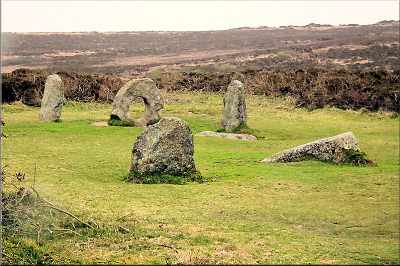 Visiting ancient sites affects our feelings and mood. You come away feeling better, your worries have gone, your view of life has changed, a smile comes to your face and you feel more whole. Have you experienced that?
Something about them is special. This is because, when you visit them, you are entering an energy-field.
Containing, fixing and enhancing energy-fields is a key reason why ancient sites exist and are placed where they are.
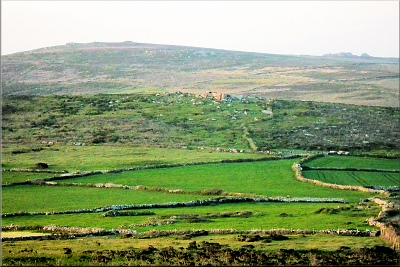
Watch Croft (left) and Carn Galva (right, distance)
 The key to understanding ancient sites lies in perceiving subtle earth energies. The ancients had a shamanistic perception seeking to harmonise with subtle energies, their periodicities and the laws of heavens and earth.
This was a practical, economic, ecological and psycho-social issue to the ancients. It is also increasingly relevant today - after all, our world is in trouble environmentally, climatically, economically, socially, technologically and... spiritually.
Studying ancient sites involves not just a fascination with the past. It concerns the future.
Privacy. This site uses temporary cookies to watch general trends only. We aren't selling anything, capturing, mining, passing on your data or making mailing lists. It's a public service - no strings. Any issues, please make contact.