Cairns and Barrows
Cairns and Barrows
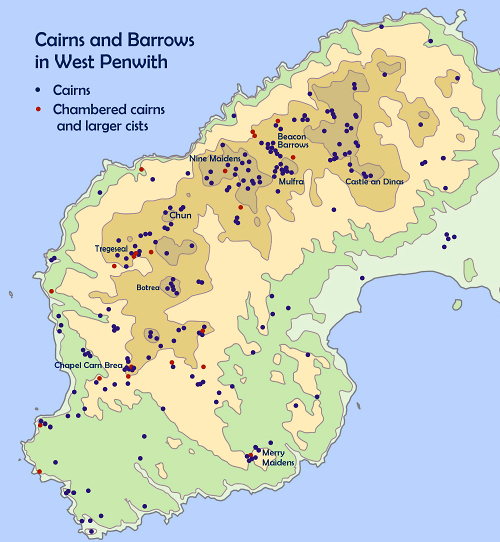
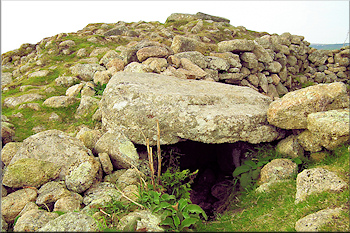 Mounds or tumuli of different kinds and sizes are the most common single form of ancient site in West Penwith - there are around 250 of them. Some have chambers with doorways, or cists (buried stone boxes), and most don't.
Many barrows are nowadays a mere bump in the heather, eroded by 3-4 millennia of Cornish weather. Some are worth visiting. Those with chambers are often misleadingly called 'chambered tombs' or 'entrance graves' - here we call them chambered cairns.
Lower down this page: Chambered Cairns - Why Build Chambered Cairns? - Repositories - Dating Cairns and Barrows - Barrows and Tumuli - Working with Energy
 Mounds probably first appeared in the Neolithic, though archaeologists usually date them to the Bronze Age after 2500 BCE. This is true in most cases, but piling up earth is a simple thing to do, and older mounds are likely.
They take on various shapes, sizes and possible functions.
Barrows and cairns have not been well and systematically investigated. Partly because of expense, partly Cornwall's geographical marginality from Oxbridge, partly the natural degradation of organic matter, and there are other reasons too. Quite a few mounds have been damaged or removed by zealous antiquarians, looters, farmers, miners, property owners and the rigours of time. Some of these we have records of, and many we do not.
Archaeologists are customarily rather fixated on their being built for burial and funerary purposes. Yes, bone and cremation remains, or grave goods, have been found at some mounds, though not always where one would expect them to be if burial were the main purpose. In many cases, chips of bones from many people together are stuffed in urns, placed in a pit and buried in mounds. Such remains were ancestral relics, or perhaps they had oracular or fertility purposes, but they represent remains from collectivities of people, not individuals. This wasn't burial - this was a shamanic practice. This said, cairns and barrows for individual burials exist too - they're often later in construction, toward the end of the megalithic period.
Burial was probably a secondary issue, carried out because the cairn or barrow was already regarded as special - therefore it was significant to be buried there.
Sometimes a cairn was covered in a layer of clay or quartz pebbles to make it stand out in the landscape. Some barrows were probably gardened to honour them and harbour certain species, to highlight them. Some mounds are placed so that they stand out on the horizon when seen from a certain direction, or from the sea.
Chy Praze kerbed cairn, near Morvah
 Thus many mounds were not built primarily for funerary purposes. They were built as shrines or depositories, or for geomantic, earth-energy or other reasons. They simply marked what were deemed to be special places.
 Yet some cairns were for burial - or at least, people were buried there. Whether burial or other purposes were the primary purpose is difficult to tell, except in the case of cairnfields, the dedicated cemeteries of the great and good. There are a few cairnfields in Penwith, such as at Mulfra and on Botrea Hill.
Chambered Cairns
Tregiffian chambered cairn, Merry Maidens complex
 West Penwith and Scilly host a unique kind of chambered cairn known as Scillonian chambered cairns. Often called 'entrance graves' or 'chambered tombs', these terms rather confuse things.
They are 'Scillonian' because the islands are littered with them. Archaeological consensus now suggests that they were first built in Penwith, then to spread to Scilly around 2250 BCE in the Early Bronze Age, when the islands were colonised.
In Penwith, in most cases, the chamber is around a metre in height and width and around 2-3 metres in length, made up of vertically-placed stones or a wall of laid stones, capped with slabs on top, many of which have a characteristic bevelled 'pillow' shape. This stone structure is buried under a mound of earth and stones. Chambers are built with tight-fitting stonework to stop the earth or stones falling in, unlike the quoits of a millennium earlier.
Around some of these cairns is a kerb of sometimes quite substantial stones inserted as an edge to the mound's perimeter. The kerb could represent an energy-containing function.
The summit cairn on Chapel Carn Brea
 The chambers weren't big, and presumably made mainly for lying in, or for placing objects inside, since in many cases they are not high enough for comfortable sitting.
A few chambers were bigger. Some cairns on Scilly are big, suggesting a communal and ceremonial function. Some cairns have cists, stone boxes in which urns, artefacts or ashes were interred. Many cairns and barrows do not - suggesting that cists, urns and ashes are secondary issues.
Surviving examples of chambered cairns in Penwith are to be found at Brane near Sancreed, Tregiffian near the Merry Maidens, Tregiffian Vean near Land's End airport, the summit cairn on top of Chapel Carn Brea, one or two cairns at Tregeseal stone circle, at Pennance near Zennor, and two at Treen above Morvah.
Most chambered cairns in Penwith probably date to around 2400-2000 BCE. Most have not been properly dated.
Ballowall Barrow, Carn Gloose, looking toward Sennen
 An exceptional chambered cairn is found at Ballowall Barrow, at Carn Gloose near St Just, in a dramatic clifftop location. It sits in a unique class of its own. It seems to have been built in stages over a long period, starting in the Late Neolithic and continuing in the Bronze Age.
Its maritime panorama is spectacular, visually connecting it with the Longships Rocks. Ballowall Barrow was also a fine location for seeing the Isles of Scilly, 25ish miles westwards over the sea, on the way toward what was then probably thought of as the edge of the world.
Why Build Chambered Cairns?
Chambers are often oriented toward points on the local horizon that mark the solstice or other rising and setting points of the sun, or of lunar standstills. They have a variety of mainly eastward orientations, and summer solstice orientations are quite common. Their builders clearly sought to capture the essence of living light at such times, or to draw light into the darkness of the underworld, or to store light or solar or lunar energy as if such cairns operated like accumulators.
Brane chambered cairn - with elaborate hair-do

Mounds were also often located on top of underground water-vortices, serving as insulated energy-chambers. Thus, earth energy would be accumulated and occasionally exposed to solar light, at certain times of year.
There is a difference between chambered cairns and solid barrows and cairns. Chambered cairns were built for initiatory, contemplative, repository, geomantic and other purposes, even as places for conscious dying. They were presumably intended for entering, though only one person at a time would fit easily, often lying down.
Truthwall Common chambered cairn, near Tregeseal stone circle
 Contemplation and spiritual training is likely to be one of the purposes of chambered cairns. They might also have been places to die consciously and in peace. Probably cairns were built not for funerary or burial purposes but for 'conscious dying'.
One interesting theory mentions molecular transfer between stones and bones (making bones more like stone and infusing chamber stones with the essence of those who have died).
They could have been places for women at critical moments of their lives, including first menstruation, preparation for pregnancy or menopause. To conceive, women might spend time in the chamber to 'call in a soul', then to emerge to a blessing ceremony and fertility rites. Doing this at summer solstice would create a child in springtime - a good time to be born.
These are hypothetical purposes for chambered cairns, yet they make sense.
Repositories
Treen South chambered cairn
 Another function of cairns is as repositories for objects - as demonstrated in many archaeological finds from chambers. This will have had a connection with soil fertility since some cairns were built close to agricultural field systems.
By interring samples of soil, ash and sand, or organic material, or offerings, such samples would become potentised, for scattering on the surrounding land to raise energy-conditions in the land - rather like scattering holy water on the land in medieval times.
Another use can be the improvement of seeds, the potentisation of herbal remedies or of psychoactive elixirs, or the application of an energy-treatment to help in the storage of food. Tools, valuables and sacred objects could be enhanced by leaving them in an energised environment.
The space inside chambered cairns was charged with negative ions and concentrated subtle energy from underground. Periodically the chambers were infused with light, penetrating the darkness to add light-filled drama an otherwise confined space.
Inside Treen South, looking out
 It's worth sitting inside a chambered cairn and letting yourself go quiet, to feel this - try Bosiliack Barrow, the Treen Barrows near Morvah, the Pennance Barrow near Zennor, or the Brane Cairn near Sancreed. They are vibrationally insulated spaces.
Then there were the ancestors, whose most enduring remains were their bones or ashes - occasionally but not always found in cairns. Ancestors' relics gave a tribe a sense of heritage, continuity, legitimacy and counsel, uplifting the soul of the tribe.
Dating
The dating of cairns and barrows in West Penwith is problematic. Barrows and cairns were commonly built from around 2500 to 1500 BCE and used over lengthy periods of time up to at least 1100. But a lack of comprehensive dating research leaves a question-mark here.
Chapel Carn Brea neolithic longbarrow
 Neolithic longbarrows were built in the 3000s BCE. Of these, there are two examples in Penwith, one safe and one possible. On Chapel Carn Brea is a Neolithic longbarrow going back to the 3000s, built on a rock outcrop in a prominent location overlooking the ocean. Close to the Brane chambered cairn is a hump which could be a longbarrow, but this is inconclusive and it has not been excavated.
Aside from archaeologists' obsession with burial, mounds have two particular purposes that are underrated.
Boscregan cairn
 The first is the simple marking of special places - some mounds are built on outcrops, clifftops or hilltops. Some are built around Neolithic tor enclosures such as Carn Galva and Carn Kenidjack. Others are out in open moorland but at the time of their building they could have been special places in glades of trees. This marking special spots goes back a long way, falling into a 'landscape enhancement' category.
The second is the entraining of underground water. It is common for cairns and barrows to be situated on top of subtle energy vortices or fields generated by underground streams that cross each other at different levels underground. Cairns would then act as buffers for energy-surges, and as subtle energy batteries.
Some cairns and barrows might be older than we currently understand. Though it's quite safe to say that most were built and used in the Bronze Age.
Solid Barrows and Cairns
Cairns atop Chapel Carn Brea
 Many mounds had no chambers - these are called barrows (made of earth) or cairns (made of stones or stones and earth). Some contain bones, urns, stones, grave goods or other items, and most do not. Their presence doesn't necessarily indicate that barrows' primary purpose was burial, since such artefacts can be buried for blessing or for empowerment of the site.
This returns us to the idea that barrows served as shrines and also in a geomantic context, located as many of them are over the intersections of underground streams. This creates a vortex, bubble or imprint of subtle energy emanating from the earth, which can be concentrated, fixed, buffered or stored in the mound.
Many barrows and cairns were multi-functional, not single-purpose.
Some archaeologists suggest that barrows, if containing funereal remains, were for protection and demarcation of a tribe's territory. This can be a form of empowerment and improvement of the land - dressing it up. In some cases they would mark special ground and territorial centres or focus-points.
Some can also serve as viewpoints from which to see other sites or landscape vistas. Some have multiple lines of sight, as seen from where they stand. Some might serve as backsights - precise positions from which, at certain times of year, the sun could be seen rising or setting over a certain feature on the horizon.
Many cairns today look inconsequential - this one near Bodrifty

Some barrows and cairns lie on alignments or alignment intersections, thus being part of the integrated alignment system of Penwith. They played an integral part in the overall geoengineering project carried out in West Penwith.
In some cases alignments pass through the centre of barrows and cairns, and in other cases they tangent their edges. Dowsers report that tangenting creates an energy-spin around the barrow or cairn, insulating it from the surrounding countryside and concentrating its energy-field.
In a more banal way, barrows could also serve simply as good places to sit and rest - Bronze Age park benches. People did a lot of walking, and barrows could serve as stopping or orientation places. In the days before maps, landmarks and paths between them were important.
Energy Working
Worse for wear - a chambered cairn at Mayon Cliff, Sennen

Some tumuli, barrows and cairns sit atop intersections of underground water veins or over geological faults.
Such conditions produce energy-conditions that permit phenomena such as time-warps, healings, insights or altered states, magnetic anomalies and an uncanny perception of centrality, of hereness and nowness. This is summed up as the 'spirit of place' or genius loci that is present at any ancient site.
The building of a mound would be to cap, contain, concentrate and entrain these energy-patterns, or to act as storage batteries or buffers for smoothing energy fluctuations. One theory has it that many barrows were built in the fashion of Wilhelm Reich's orgone accumulators, with alternating layers of organic matter (turf, compost or soil) and inorganic matter (stones, sand or gravel) laid down in order to accumulate subtle energy.
In West Penwith many mounds have stones resting on or embedded in them, and some are also built over rock outcrops. Perhaps this was why chambered cairns have stone chambers and external stone kerbs - a form of alternation of earth and stone.
One of the big platform barrows on Botrea Hill
 Further purposes of solid mounds can be for raising the water table, creating bio-generators for helping biodiversity and land fertility, energy-buffers for weather moderation, sites for ceremony or a number of other functions - and different functions for different sites, each according to its character. This would operate by regulating or storing vortical fluctuations of energy at water-line intersections and blind springs.
This energy-working component is likely to be one of the main reasons for constructing many mounds. It is notable that many burial barrows and cairns tend not to sit on such energy-centres.
Bosiliack Barrow

While we do not know what really went on in the thoughts and beliefs of Neolithic and Bronze Age people, the above conjectures nevertheless give us hints about the purpose and use of these sites.
Imagination perhaps, but there is a difference between plausible imagination and wishful thinking, and modern rationality fails to distinguish them.
Cairns & Barrows
A selection. Bronze age barrows, tumuli and cairns - solid, sometimes with urns or cists inside, sometimes kerbed with stones. Bronze Age chambered cairns are in green and Neolithic longbarrows are in light blue.
Ballowall Barrow At Carn Gloose. Complex late Neolithic/Bronze Age chambered cairn in a dramatic clifftop location, built and modified in several stages. SW 3552 3125. 50.122261 -5.7014816.
Boscregan Cairns Three prominent clifftop cairns with cists or chambers, the southernmost being kerbed. SW 3579 2983. 50.109636 -5.6967298. See also Carn Creis and Letcha Cairn.
Bosiliack Barrow Late Neolithic chambered cairn, excavated and reconstructed. SW 4311 3421. 50.152162 -5.597515.
Boskednan N Large Bronze Age kerbed cairn, NW of Nine Maidens. SW 4324 3530. 50.162011 -5.596155.
Boskednan S Boskednan southern cairn, SE of Nine Maidens. SW 4350 3495. 50.158973 -5.592565.
Botallack Common Botallack Common barrow. One of several cairns in the Tregeseal complex. SW 3906 3260. 50.135944 -5.6529871.
Botrea Barrows Four Bronze Age platform barrows with panorama. SW 4033 3107. 50.122821 -5.6342901.
Brane Cairn Chambered cairn, intact. SW 4013 2818. 50.096767 -5.6350595.
Brane Longbarrow Neolithic long barrow – indistinct, unexcavated. SW 4018 2801. 50.095238 -5.6342231.
Carn Bean Two hilltop barrows on Carn Bean, part of Tregeseal complex. SW 3827 3314. 50.140443 -5.6643893.
Carn Creis Two clifftop barrows. One a denuded cairn with cist, the other with a propped central boulder and large kerb. SW 3577 2969. 50.108473 -5.6965.
Carn Lês Boel Cairn. Part of a possible complex of rock and cairn features. SW 3571 2325. 50.050583 -5.6932442.
Carn Lês Boel barrow. Carn Kenidjack is visible from the barrow, six miles away. SW 3578 2331. 50.051115 -5.6923656.
Chapel Carn Brea 2 Scillonian Chambered Cairn - summit cairn. SW 3860 2810. 50.095353 -5.6563291.
Chapel Carn Brea Longbarrow Neolithic hilltop long cairn. SW 3857 2799. 50.094352 -5.6566724.
Chy Praze Chy Praze or Carn Clough clifftop kerbed cairn with cist or chamber. SW 3929 3588. 50.165484 -5.6520199.
Conquer Cairn Bronze age cairn, aka Little Carnaquidden. Astronomically aligned to Beltane sunset as seen from Castle an Dinas. SW 4761 3546. 50.165316 -5.5354771.
Escalls Cliff cairn. SW 3622 2722. 50.086214 -5.689192.
Gundry Cave kerbed cairn. SW 4582 3767. 50.184388 -5.5619672.
Hannibal's Carn Cairn SW 4330 3590. 50.167414 -5.5960003.
Joppa Two barrows, one a ring barrow, aka Numphra. SW 3796 2964. 50.108983 -5.6663216.
LADY DOWNS B Bronze age barrow, aka Conquer Downs. SW 4699 3610. 50.170797 -5.5445666.
Lanyon Longbarrow Neolithic long barrow. Alleged to have originally covered Lanyon Quoit, but more likely to have adjoined it. SW 4297 3367. 50.147255 -5.5991067.
Letcha Cairn Clifftop kerbed cairn. SW 3570 3025. 50.113366 -5.6982765.
MAYON CLIFF 1 Round chambered cairn or cairn with cist, aka Carn Men Ellas. SW 3481 2602. 50.075005 -5.707763.
Nine Maidens Downs cairn, aka Tuban Broze, large and dilapidated. SW 4365 3521 50.161372 -5.5906447.
Pedn Mên Du tumulus. SW 3486 2607. 50.075477 -5.7071004.
Pennance 1 or Giant's Craw. Late Neolithic chambered cairn, quite intact. SW 4476 3753. 50.182423 -5.576112.
Pordenack Kerbed, clifftop chambered cairn, Bronze Age, damaged. SW 3468 2418. 50.058344 -5.7082937.
Portheras Common Kerbed round barrow with cist. SW 3914 3327. 50.141993 -5.6523284.
Rosewall Hill Two Bronze Age kerbed cairns. SW 4922 3917. 50.199520 -5.517122.
SANCREED BEACON round barrows. SW 4143 2947. 50.108887 -5.61777.
Treen Two Scillonian chambered cairns. SW 4380 3715. 50.178858 -5.589575. SW 4384 3710. 50.178418 -5.589262.
Tregeseal chambered cairn. SW 3805 3213. 50.131281 -5.6667678.
Tregiffian Scillonian chambered cairn. Late Neolithic, re-modelled in the Bronze Age. Part of Merry Maidens complex. SW 4304 2443. 50.064336 -5.5919434.
Tregiffian Vean Scillonian chambered cairn, in poor condition. SW 3725 2773. 50.091436 -5.67491.
Trendrine Cairns. Fine panorama. SW 4787 3875. 50.194959 -5.5340247.
Trewey 1 Likely late-Neolithic chambered cairn. SW 4596 3754. 50.183281 -5.5599232.
TRUTHWALL COMMON Bronze age chambered cairn, plus three barrows, some with cists. Part of Tregeseal complex. SW 3891 3258. 50.135699 -5.6550680.
WATCH CROFT cairn, built of stones. SW 4206 3572. 50.165213 -5.6132149.
Watch Croft cairn. SW 4204 3569. 50.164982 -5.6134778. West Penwith's highest point.
Next, we move into the Bronze Age period. This started with a transitional phase called the Neolithic-Bronze Age transition (NBA, or the Copper or Chalcolithic Age) before the Bronze Age properly gathered steam.
Privacy. This site uses temporary cookies to watch general trends only. We aren't selling anything, capturing, mining, passing on your data or making mailing lists. It's a public service - no strings. Any issues, please make contact.